Activities & everyday play
7 Low-Prep Dog Enrichment Ideas Using Things You Already Have
A familiar toy. A sniffing pause. A little choice. Pick one idea that suits your dog today.
- 7 practical options
- Familiar supplies
- Your dog can decline
You have a dog, a few familiar toys, and a gap in the day. What you do not have is the energy to build a miniature obstacle course in your living room. These dog enrichment ideas start with ordinary things: a toy your dog already likes, your usual walking route, a clear patch of floor, and your attention.
The aim is to offer an enjoyable opportunity, watch how your dog responds, and keep the parts that suit them. There is no seven-day challenge to complete. You can choose one idea, repeat a favorite, or decide that your dog would rather rest.
Before you choose an enrichment activity
Enrichment gives a dog opportunities to explore and engage with their surroundings. Dogs Trust recommends choosing activities around the individual dog's needs and preferences, using suitable materials and watching for frustration. That principle matters more than making a game look impressive in a photograph.
Look at the dog in front of you. Are they approaching comfortably? Are they interested in a toy? Are they already asleep? Pick a moment when you can pay attention rather than treating an activity as a way to disappear into another room. The examples here are invitations for time together, not unattended entertainment.
Check your materials first. Toys should be intact and suitable for your dog's size and play style. Choose stable, accessible spaces without slippery surfaces, trailing cables, or objects your dog might swallow. Avoid forcing movement, reaching into a guarded mouth, or making a dog climb to find something. If a material regularly gets shredded or eaten, use a different option.
Stop or simplify if your dog turns away, seems worried, or becomes frustrated. Persistent changes in behavior, discomfort, or concerns about activity suitability belong with your veterinarian or a qualified behavior professional. An activity sheet cannot assess an individual dog's health.
A quick way to choose today's idea
Ask three questions before setting anything up: where are we, what does my dog seem interested in, and can I stay involved? An indoor toy choice might fit a quiet afternoon. A sniffing pause may fit a walk you are already taking. A calm same-room moment might be the best choice when both of you need less activity.
| Your situation | Try first | Keep in mind |
|---|---|---|
| Indoors with familiar toys | The two-toy vote | Choosing neither is allowed |
| Your dog enjoys finding a toy | The visible-toy discovery | Make the first attempt very easy |
| Already on a suitable walk | The slow sniff stop | Stay on a permitted, safe route |
| A quiet part of the day | The same-room companion | No touching or participation required |
You do not need a different activity for every day of the week. A small collection of things your dog enjoys is more useful than a large folder of ideas you never try. Think of these seven options as a menu, with room to change your mind.
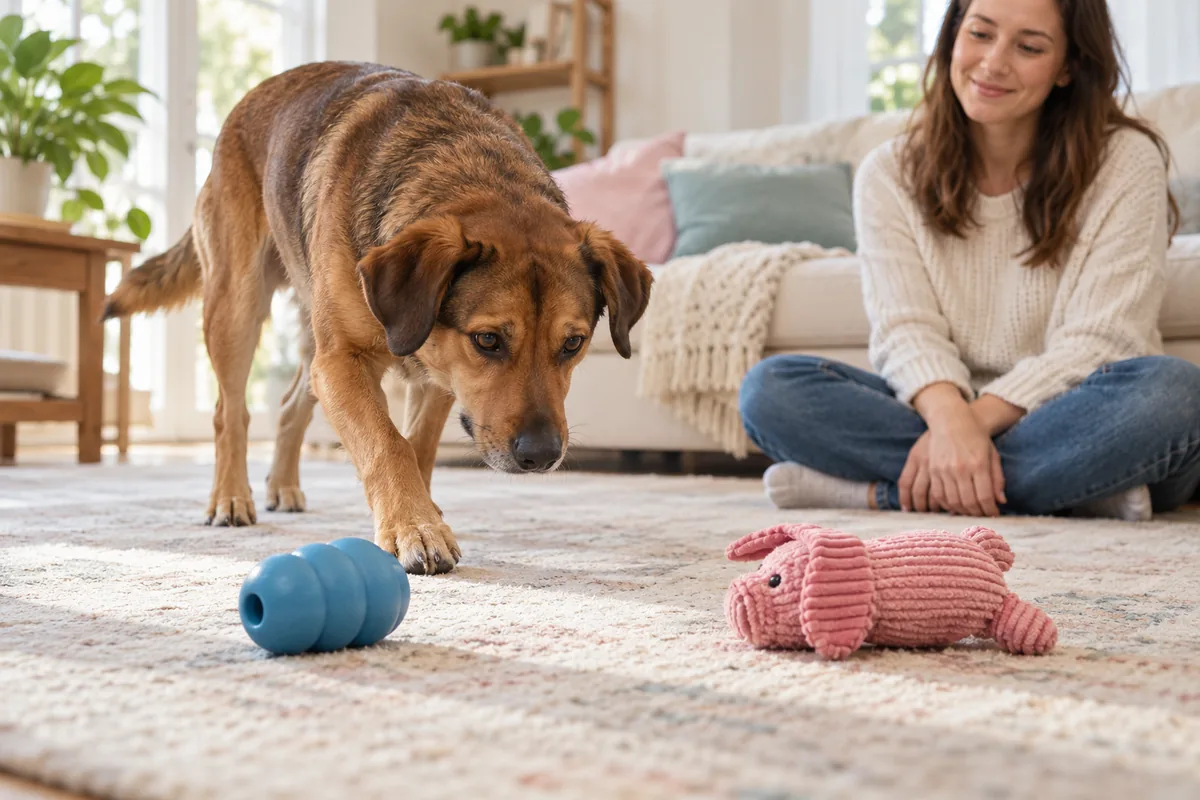
1. Let your dog choose between two familiar toys
Put two suitable dog toys apart on a clear floor. Give your dog room to approach, sniff, pick one, or leave both alone. Avoid waving the toys in their face or repeatedly asking them to choose. The interesting part is seeing what they do when there is no pressure to perform.
If your dog brings a toy to you, join the familiar kind of play they invite. Keep the interaction comfortable and pause when their interest changes. If they simply sniff a toy and wander off, that is useful information too. You offered a choice; you did not set an exam.
For an easier version, offer just one favorite toy and wait. If there is tension around toys or other dogs, skip the shared setup and ask for individual guidance. Write down which toy your dog approached so you can remember their preference next time.
2. Make a favorite toy easy to discover
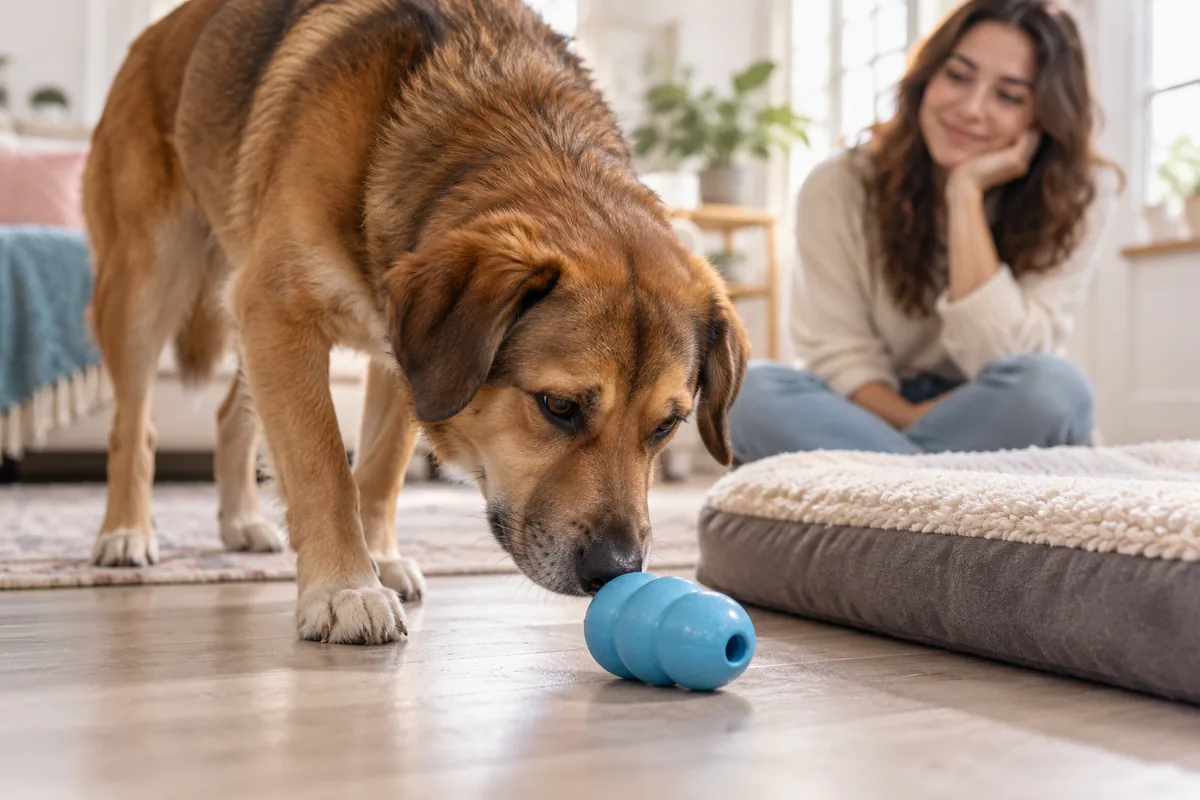
Let your dog watch while you place a familiar toy partly in view on an accessible floor. Keep it close enough that finding it does not require climbing, crawling through a tight space, or moving furniture. Then give your dog time to investigate without moving their body toward the answer.
The first attempt can be almost comically easy. That is the point. You are finding out whether this kind of discovery interests your dog, not trying to prove how clever they are. If they approach the toy, let the discovery turn into their usual play if they want it to.
If they look confused, return the toy to full view or offer it normally. Do not keep increasing difficulty because a video made a complicated search look entertaining. One comfortable discovery is enough to tell you whether you would like to try again another day.
3. Add a slow sniff stop to an ordinary walk
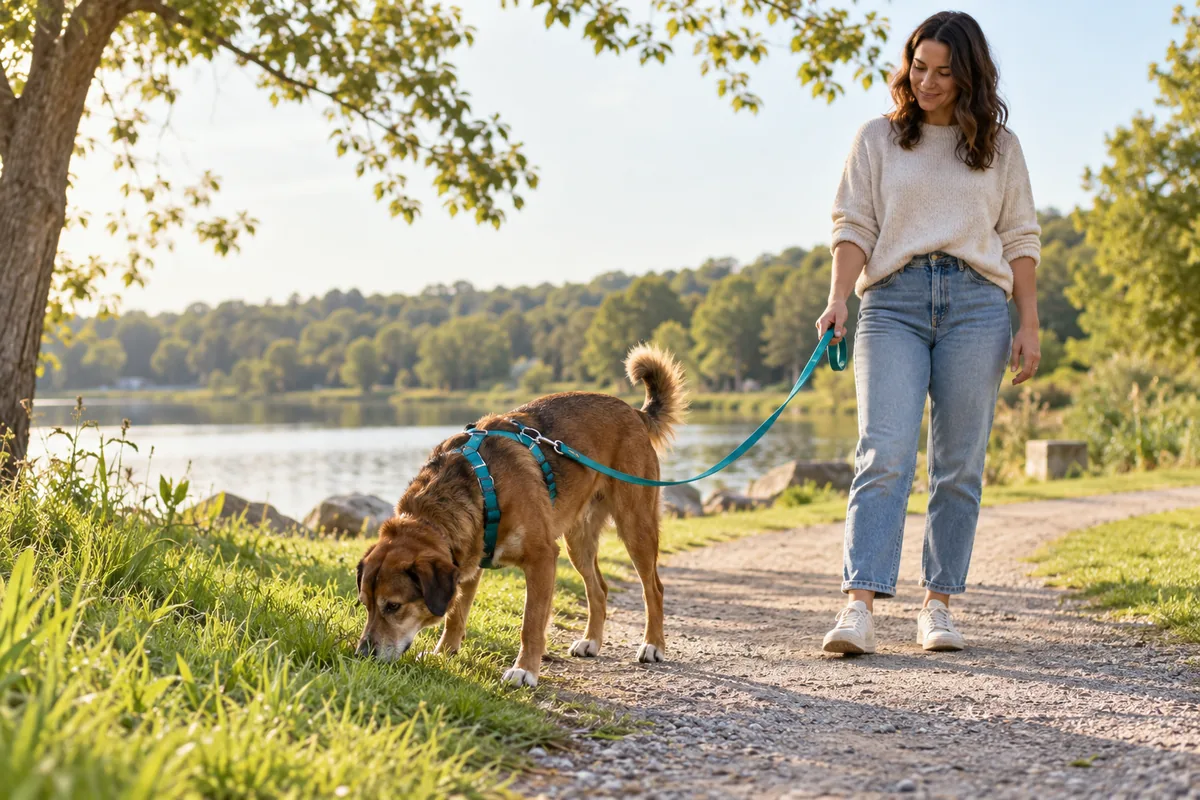
On your usual permitted route, choose an accessible spot where your dog can investigate without being near traffic, litter, unknown plants, or wildlife. Use your regular secure walking equipment. Pause and allow some room for sniffing instead of turning every stop into a request to move faster.
You do not need a new destination or a longer walk to notice one familiar place differently. Let your dog set the pace of that small pause, within the boundaries of a safe outing. If the area is busy or your dog seems uncomfortable, move on to somewhere more suitable.
Afterward, make a short note: which location interested them, and was it comfortable? That makes the next choice easier. Follow local rules and veterinary advice about outings, particularly for puppies or dogs with health restrictions. This idea does not prescribe exercise duration.
4. Bring back an overlooked favorite
Look through toys you already own and choose one your dog has enjoyed before. Inspect it for damage before offering it again. Place it in an open area and let your dog decide whether it is interesting today. The setup is simply a small change in what is available.
There is no need to announce a dramatic surprise or add food to make the toy appealing. Some dogs will immediately recognize it; others will carry on with their day. Either response helps you choose what belongs in your active toy collection.
Keep a brief favorites list rather than buying replacements for every quiet moment. Record the toy's name or take a picture for your own reference. If a toy no longer suits your dog's play style, retire it. Familiar does not automatically mean suitable forever.
5. Offer a gentle floor-level roll
If your dog already enjoys a suitable rolling toy, choose a clear, nonslip floor and roll it gently over a short distance. Keep the movement at floor level. You are inviting familiar play, not asking for jumps, sharp turns, or a fast chase through furniture.
Let your dog decide whether to follow. If they retrieve it, you can repeat the familiar interaction while it remains comfortable. If they watch it roll without moving, do not insist. Try a stationary toy choice instead, or leave the activity for another day.
This option is only for dogs whose normal play and physical needs make it suitable. Skip it if movement is restricted or the space is awkward. A smaller room is a reason to choose a quieter activity, not to squeeze an energetic game between chair legs.
6. Enjoy one cue your dog already knows
Choose an easy, familiar cue that your dog performs comfortably. Use the same wording and approach your household already uses, then offer a reward that is appropriate for your dog. Keep it light and leave room for them to disengage.
This is a chance to enjoy a known interaction, not a plan for teaching a new trick. Avoid turning a pleasant moment into repeated requests until the dog gives up. If the familiar cue does not feel easy today, stop and choose something with fewer demands.
You can record the cue and what worked in a shared note so different caregivers do not accidentally use different signals. For help teaching skills or addressing behavior concerns, use a qualified reward-based trainer. The notes here are about organizing your own everyday interactions.
7. Make room for a quiet same-room moment
Choose a place your dog already finds comfortable. Sit nearby with a book, a cup of tea safely out of reach, or nothing at all. Allow your dog to join you, stay at a distance, or settle elsewhere. They do not need to pose, be stroked, or stay on a particular mat.
This is a quiet companionship option rather than a game, and it belongs on the menu because every shared moment does not need a puzzle. Watch what your dog actually chooses instead of assuming proximity means they want touch.
If the surroundings become unsettling, change the setting or end the moment. A busy window, visitors, or household noise may make another location more comfortable. Keep this idea available for days when adding more novelty would create work for both of you.
Turn a good idea into something you can repeat
After trying an option, record three small details: what you offered, how your dog responded, and what you would change. “Blue toy; approached straight away; use the clear hallway again” is enough. A useful note saves you from reconstructing the whole setup next week.
For a shared household, add who tried it and whether the activity materials have been put away. Keep observations concrete. “Walked away after one roll” tells the next person more than “was stubborn.” Your record is a description, not a diagnosis or a score.
You can keep these notes on paper, in a simple document, or in a tool you already use. the activity-planner app in Woof Life is an optional next step when you want to choose practical activity pages, write your own ideas, and keep favorites in printable decks. Its downloaded browser app stores saved work locally, so regular exported backups matter.
The free Adult-Dog Activity Pack offers a smaller starting point: three activities and four reusable printables across eight pages. Use the tracker to note what happened and the caregiver page to leave the next person a clear handoff. It is a starter pack, not a veterinary care plan.
Questions about easy dog enrichment
Can dog enrichment be done without food?
Yes. The seven options above use familiar toys, sniffing opportunities, known interactions, or companionship. You do not need to add food to every activity. Choose around your dog's preferences and individual needs.
How long should an activity last?
There is no required session length in this list. Keep watching your dog and stop, simplify, or move on when appropriate. Your available time is a planning detail, not a prescription for exercise or stimulation.
What if my dog ignores the idea?
Leave room for that response. Check the setting and the materials, then offer something easier or stop. Repeatedly increasing the difficulty or excitement is not a reliable way to make an unsuitable option enjoyable.
Does the free pack contain all seven activities?
No. This article gives seven options. The separate free pack contains three activity pages, four reusable printables, and its introduction. Subscribe and confirm your email to receive its download link.
Sources and further reading
Our activity examples draw on Woof Mom's original activity material. For general enrichment selection, see Dogs Trust: enrichment activities for dogs. For home-environment guidance, see RSPCA: creating a good home for your dog. This article offers everyday ideas and organization, not individual training or medical assessment.
Illustrative images generated for this guide.