
Routines & household care
A Puppy Routine That Fits Your Household: Start with Five Daily Anchors
Keep the next task clear without making every day follow an identical timetable.
- 5 household anchors
- Done · next · who
- A worked weekday example

A daily puppy routine is easier to use when it reflects the household you actually live in. You may work from home, leave for a shift, share care with someone else, or have a week that never looks the same twice. A rigid timetable copied from another family cannot account for all of that.
Start with five household anchors: begin the day together, make the next task visible, check in or confirm coverage, reset the notes, and leave tomorrow a small head start. These anchors organize the people and information around your puppy. They do not set feeding intervals, toilet breaks, exercise requirements, or safe time alone.
What a flexible puppy schedule should do
A useful puppy schedule tells you what needs attention, what has already happened, and who is responsible next. It should make the ordinary handoffs easier without encouraging anyone to delay care because a box says the next check-in is later.
Build the actual care plan with the guidance appropriate for your puppy. The RSPCA's puppy-care information covers preparation, rest, and individual care considerations. Use qualified advice for health, feeding, outings, and development; use your household routine to keep that advice visible and coordinated.
There are two layers to the plan. The care layer contains the individual needs and instructions you follow. The organization layer contains reminders, names, notes, and supplies. This article focuses on the second layer, so it can adapt around different ages, work patterns, and family arrangements.
If your puppy needs attention before your next planned check-in, attend to that need. If an arrangement proves inadequate, change the coverage. A neat printable should help you notice a gap, not persuade you that the gap is acceptable.
Anchor 1: Start together
When your household's morning begins, check on your puppy, respond to immediate needs, and look at today's care plan. Your wake time gives the plan a recognizable starting point. It is not a rule that your puppy must wait until you are ready.
Check the practical details that can change from one day to the next. Is someone working late? Is an appointment booked? Is the usual caregiver unavailable? Put those exceptions beside the ordinary plan so they are not discovered at the last minute.
Keep this first anchor short. You are trying to see the day, not write a diary before breakfast. A line such as “appointment this afternoon; Jo handles the handoff” may be all the extra information you need.
If you live alone, use the same check with your backup arrangement in mind. Know who you can contact if the day changes. Keeping a name and number on the plan is more useful than assuming you will remember every option when something interrupts you.
Anchor 2: Make the next step visible
After the morning starts, record what has already happened and name the next care task. Use an observable description rather than a vague status. “Morning care recorded; Casey covering next check-in” gives the next person something to act on.
Choose one place for that note. It might be the daily tracker in your printable pack, a shared household sheet, or a document everyone can reach. The best choice is the one your caregivers will use consistently, not the one with the most elaborate design.
Keep the wording predictable: done, next, who. A caregiver should not need to translate three different styles of update to discover whether a task has happened. If the next action depends on professional instructions, point to the instructions instead of rewriting them from memory.
This anchor is especially helpful when mornings overlap. Someone may be getting ready for work while another person is supervising the puppy. A visible note removes the need to hold every detail in a spoken conversation at the doorway.
Anchor 3: Pause and check in, or confirm care coverage
Use the next sensible household check-in to review your puppy's needs and update the notes. For a predictable day, that might sit around a midday handoff. For a variable schedule, tie it to the next caregiver change rather than a clock time that never works.
If you are working from home, put a reminder where you will see it between work blocks. Being in the same building does not mean every task happens automatically. The reminder should bring your attention back to the care plan and any immediate needs.
If you will be away, confirm the caregiver and the actual care arrangement before leaving. Record who has accepted the handoff and how they can contact you. “I sent a message” and “the coverage is confirmed” are different states; the plan should make that distinction clear.
This anchor does not calculate a safe period alone. A work shift is not a care prescription. If the arrangement cannot cover your puppy's needs, solve that gap with suitable help and professional guidance before relying on the timetable.
Anchor 4: Reset the notes after activity or a caregiver change

Reset means notice what your puppy needs now, record care already given, and leave the next caregiver the relevant information. It does not mean starting the whole routine again or making a puppy repeat something for the sake of a fresh page.
Write the smallest complete handoff. Include what happened, anything the next person needs to know, and what comes next. For example: “Outdoor time recorded; green toy put away; next caregiver is Lee.” Add care-specific details where necessary, following the instructions you already use.
Describe observations without assigning a motive. “Walked away from the toy” is clearer than “didn't behave.” “Settled in the quiet area” is clearer than “finally good.” Concrete notes help everyone respond to the same information.
If a handoff repeatedly causes confusion, improve that one instruction. You do not need to redesign the entire week. Add the missing location, the relevant contact, or the name of the person responsible. A small correction is often easier to keep than a new system.
Anchor 5: Leave tomorrow a small head start
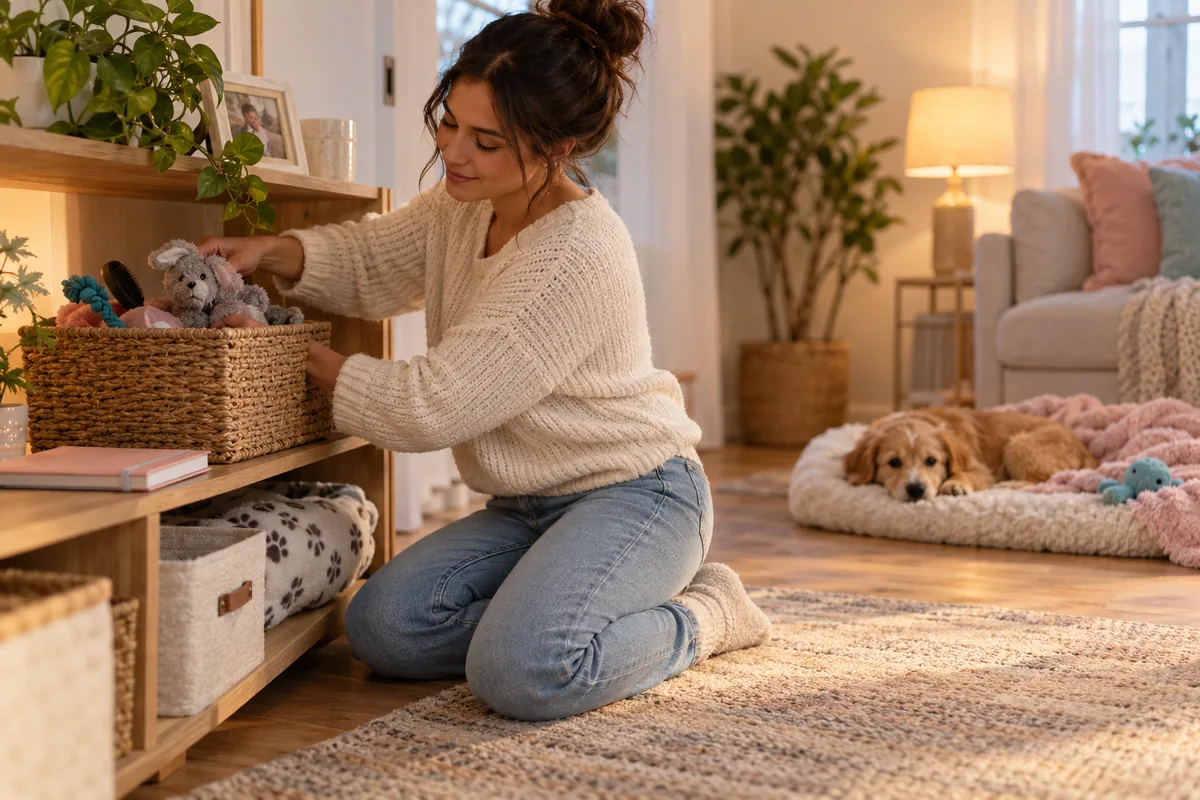
As the household winds down, look at the next care task and tomorrow's coverage. Put your usual supplies where you expect to find them, check the information that needs updating, and note any change in who is available.
Choose one practical improvement rather than a complete reset. Refill a supply you know is running low. Move the contact sheet to a better location. Confirm tomorrow's caregiver. The goal is to remove one piece of friction from the next morning.
Leave room for quiet time and for care needs that do not follow your ideal schedule. This anchor is about household preparation. It is not a training instruction to make a puppy sleep at a particular time or ignore them if they need help.
You can finish with one ordinary good thing: a comfortable shared moment, an easy handoff, or a task someone remembered without being prompted. Recording a small win makes the plan a place for progress as well as unfinished work.
A worked example: a shared weekday
Imagine a fictional household with two caregivers, Riley and Morgan, and a puppy named Pip. Riley's workday begins at home; Morgan leaves earlier and returns later. They already have individual care guidance for Pip. Their organization plan adds names and handoffs around that guidance.
| Anchor | Household note |
|---|---|
| Start together | Riley checks today's plan and responds to Pip's immediate needs |
| Make the next step visible | Record completed care; Riley covers the next task |
| Check in / coverage | Confirm backup help before Riley's unavailable work block |
| Reset the notes | Leave Morgan a done / next / who update at handoff |
| Prepare tomorrow | Check the next appointment and confirm morning coverage |
The table deliberately leaves out universal meal times, toilet intervals, and exercise durations. Those details belong to Pip's actual care plan. The household anchors make the plan easier to follow without pretending that every puppy has the same needs.
Now imagine Riley's work call moves. They change the named coverage and update the note. They do not wait for the old check-in time because it is printed on a sheet. That ability to adjust is the main benefit of a flexible routine.
Adapt the routine around work and variable days
For working owners, the most useful starting question is “Who covers the time I cannot?” Put your actual unavailable periods on paper, then identify the appropriate care arrangements. Do this before choosing attractive time labels for a printable.
If your days vary, use event-based prompts. “After the caregiver changes” may be more reliable than a fixed afternoon time. “Before leaving for work” may remind you to confirm coverage better than a generic morning checklist. Keep the care itself guided by your puppy's needs.
When several people help, check that everyone knows where the current version lives. An old photo of a plan can create confusion if the coverage has changed. Date meaningful updates and remove versions that no longer apply.
When you are the only regular caregiver, make the handoff sheet ready for occasional help. Include the location of supplies and the relevant contacts before a backup person needs them. A little preparation makes unexpected assistance easier to arrange.
Make your puppy routine printable useful
A printable should have enough room for the information you actually use. Keep your personalized routine nearby, use the daily tracker for completed care, and reserve the handoff page for the details another caregiver needs. Do not duplicate the same note across every sheet.
The free Puppy Routine Quiz asks seven quick questions about your puppy and household. It produces a six-page pack: your personalized routine and focus points, daily tracker, handoff sheet, setup checklist, care notes, and weekly wins. You receive the delivery link after subscribing and confirming your email.
Open the personalized link in the browser where you completed the quiz. Your answers are retained there, with a recovery copy that lasts 24 hours. Save the generated PDF while the result is available so you can keep and print it later. The separate downloadable quiz app does not recover an earlier online result.
If you prefer writing by hand, print the pages you need rather than producing a new full pack every day. If paper stops being convenient, the care-journal app in Woof Life offers an optional downloaded browser app for routines, dated records, care plans, and notes. Its data stays in your browser on your device; export backups regularly because there is no automatic cloud sync.
Use a weekly review to remove friction
At the end of the week, look for one recurring problem. Perhaps the next caregiver was unclear, a supply was stored in the wrong place, or the handoff note became too long. Choose one change you can explain in a sentence.
Keep the parts that worked. A routine does not need a complete redesign because Tuesday was messy. You can maintain the same anchors while adjusting people, locations, and reminders. That consistency makes the next version easier to understand.
Look back at your observations without grading yourself or your puppy. The purpose of the notes is to support the next decision. A useful review ends with something practical, such as “put the tracker beside the supplies,” rather than “be more organized.”
Daily puppy routine questions
Should a puppy have a strict schedule?
Use predictable household arrangements alongside care that responds to the individual puppy. The five anchors here organize people and information; they do not require a puppy to wait for a fixed time when they need attention.
Does this routine change by age?
Individual care needs can change with age and circumstances. Ask your vet and qualified trainer for appropriate guidance. The organizational anchors can remain useful while the actual care plan changes.
Can I use this when I work away from home?
Yes, as an organization tool, with suitable care coverage already arranged. It cannot establish how long your puppy can be alone or make an uncovered workday appropriate.
What if I miss an anchor?
Respond to your puppy's current needs, check what has happened, and update the next task. You do not need to recreate a perfect sequence or repeat completed care to catch up with the page.
Sources and further reading
For general care context, see RSPCA: caring for your puppy. For consistent household approaches, see Dogs Trust: teaching your puppy good habits. The five anchors and worked household example come from Woof Mom's original routine tool and editorial planning.
Illustrative images generated for this guide.